4597 search results - page 509 / 920 » Structuring Agents for Adaptation |
149
click to vote
ICASSP
2008
IEEE
16 years 1 months ago
2008
IEEE

Newborns must learn to structure incoming acoustic information into segments, words, phrases, etc., before they can start to learn language. This process is thought to rely on mod...
195
click to vote
SMI
2008
IEEE
16 years 1 months ago
2008
IEEE
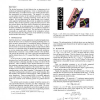
The skeletal structures of solid objects play an important role in medical and industrial applications. Given a volumetrically sampled solid object, our method extracts a nice-loo...
213
Voted
TSP
2010
15 years 1 months ago
2010

Abstract--An efficient and flexible dictionary structure is proposed for sparse and redundant signal representation. The proposed sparse dictionary is based on a sparsity model of ...
200
Voted
GECCO
2007
Springer
16 years 1 months ago
2007
Springer
An agent population can be evolved in a complex environment to perform various tasks and optimize its job performance using Learning Classifier System (LCS) technology. Due to the...
175
click to vote
ATAL
2005
Springer
16 years 12 days ago
2005
Springer

There has been a growing interest in designing multi-agent based interactive dramas. A key research challenge faced in the design of these systems is to support open-ended user in...