3126 search results - page 338 / 626 » Holographic representations of images |
194
click to vote
BIBE
2001
IEEE
15 years 10 months ago
2001
IEEE

Different modalities in biomedical imaging, like CT, MRI and PET scanners, provide detailed crosssectional views of the human anatomy. The imagery obtained from these scanning dev...
217
click to vote
CVIU
2007
15 years 6 months ago
2007

The problem of face detection remains challenging because faces are non-rigid objects that have a high degree of variability with respect to head rotation, illumination, facial ex...
260
click to vote
CVPR
2011
IEEE
15 years 2 months ago
2011
IEEE
We describe an imaging architecture for compressive video sensing termed programmable pixel compressive camera (P2C2). P2C2 allows us to capture fast phenomena at frame rates high...
172
click to vote
TMI
2011
15 years 1 months ago
2011
—The 4D extended Cardiac-Torso (XCAT) phantom was developed to provide a realistic and flexible model of the human anatomy and cardiac and respiratory motions for use in medical ...
224
click to vote
CVPR
2009
IEEE
17 years 1 months ago
2009
IEEE
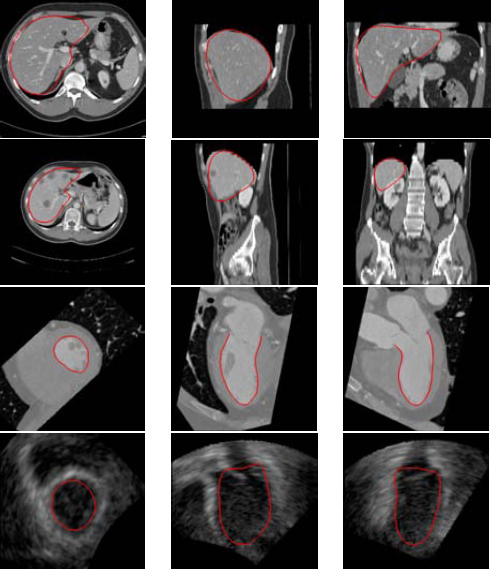
Recently, we proposed marginal space learning (MSL) as
a generic approach for automatic detection of 3D anatom-
ical structures in many medical imaging modalities. To
accurately...