5046 search results - page 233 / 1010 » Feature Selection from Huge Feature Sets |
192
Voted
PAMI
2007
15 years 6 months ago
2007

—Fingerprint friction ridge details are generally described in a hierarchical order at three different levels, namely, Level 1 (pattern), Level 2 (minutia points), and Level 3 (p...
190
click to vote
NAACL
2004
15 years 8 months ago
2004

We examine the utility of multiple types of turn-level and contextual linguistic features for automatically predicting student emotions in human-human spoken tutoring dialogues. W...
201
click to vote
CVPR
2008
IEEE
16 years 8 months ago
2008
IEEE
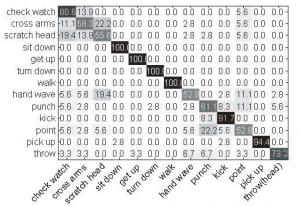
In this paper, we propose a framework that fuses multiple features for improved action recognition in videos. The fusion of multiple features is important for recognizing actions ...
152
click to vote
SMA
2005
ACM
16 years 5 days ago
2005
ACM
In the parametric feature based design paradigm, most features possess arguments that are subsets of the boundary of the current model, subsets defined interactively by user sele...
182
click to vote
ILP
2004
Springer
15 years 12 months ago
2004
Springer

Random forest induction is a bagging method that randomly samples the feature set at each node in a decision tree. In propositional learning, the method has been shown to work well...