168
click to vote
CHI
2009
ACM
16 years 7 months ago
2009
ACM

Ninety million Americans have inadequate health literacy, resulting in a reduced ability to read and follow directions in the healthcare environment. We describe an animated, empa...
158
click to vote
CHI
2009
ACM
16 years 7 months ago
2009
ACM
The Codex is a dual-screen tablet computer, about the size of a 4"x6" day planner, with a self-supporting binding and embedded sensors. The device can be oriented in a v...
198
click to vote
CHI
2009
ACM
16 years 7 months ago
2009
ACM
Digital pen systems, originally designed to digitize annotations made on physical paper, are evolving to permit a wider variety of applications. Although the type and quality of p...
177
click to vote
CHI
2009
ACM
2009
ACM
Measuring the impact of third place attachment on the adoption of a place-based community technology
16 years 7 months ago
CoCollage is a placed-based community technology that leverages the power of online social networking to facilitate awareness and face-to-face interactions in a third place. We ad...
163
click to vote
CHI
2009
ACM
16 years 7 months ago
2009
ACM
Sites like YouTube offer vast sources of data for studies of Human Computer Interaction (HCI). However, they also present a number of methodological challenges. This paper offers ...
150
click to vote
CHI
2009
ACM
16 years 7 months ago
2009
ACM
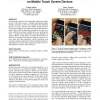
Zooming user interfaces are increasingly popular on mobile devices with touch screens. Swiping and pinching finger gestures anywhere on the screen manipulate the displayed portion...
168
click to vote
CHI
2009
ACM
16 years 7 months ago
2009
ACM
Territoriality, the expression of ownership towards an object, can emerge when social actors occupy a shared social space. In the case of Wikipedia, the prevailing cultural norm i...
106
Voted
CHI
2009
ACM
16 years 7 months ago
2009
ACM
159
Voted
CHI
2009
ACM
16 years 7 months ago
2009
ACM
Urban designers and urban planners often conduct site visits prior to a design activity to search for patterns or better understand existing conditions. We introduce SiteLens, an ...
193
click to vote
CHI
2009
ACM
16 years 7 months ago
2009
ACM

One approach to reducing the costs of usability testing is to facilitate the automatic detection of critical incidents: serious breakdowns in interaction that stand out during sof...